Showing posts with label ServiceLearning-AA. Show all posts

Monday, March 20, 2017

Garbology!!


Collecting garbage from cans around campus
Of all the various extracurricular projects I worked on this quarter, ranging from running microplastics and anthropology booths during Earth Day, and during the Club Fair, to functioning as a group lead during Stolja Ali (Gold Park) restoration projects, water quality monitoring and co-authoring the Anthropology Departments Salmon Report for Japanese and Big Gulch in Mukilteo (https://www.academia.edu/30938171/A_Survey_of_Fish_and_Wildlife_Japanese_and_Big_Gulch_2016), I am most proud of my involvement in the Garbology project run through the Campus Sustainability Club with assistance from CSEL and the Green Team.
Students getting involved collecting data :)
This project was the culmination of many quarters here at EdCC working to educate students and faculty about the impacts their choices of which products to consume have on the environment, and of how our waste stream is largely something that we don't think about. A "garbology" is a study of waste, in this case our project sought to analyze how effectively trash, recycling, and compost were disposed of on campus. By sorting through the recycling and garbage bins, weighing the contents, then recording how much of each bag was actually recycling, garbage, or compost, we were able to roughly estimate how effective our campus is at disposing its waste properly.
Supervising the recording of data
As the project lead, I was responsible for the set up, coordination of volunteers, data recording, sorting and final disposal of waste, and wrap-up for both days I ran the garbology event. This amounted to a little more than 9.5 hours the first day, and 6 hours the second day, for a total of just over 15 hours. This doesn't include time spent preparing procedures, coordinating with campus staff, and actually planning this project. 

This relates to animal biology because the waste that our society produces directly impacts the survival of many species. The effects of plastics on species of seabirds such as albatross are well documented, and the link between our disposal of these products and the actual impact on wildlife often goes unrepresented in discussions. (https://drive.google.com/open?id=0B_-IlzDDqpjSamxHeGw2elRPWlU) This particular link has been the subject of a great deal of research and effort on my part as I attempt to bring this information into the zeitgeist of our campus community.


Having a blast sorting trash

The overall goals of this project were twofold. Initially, the project design sought to provide visibility to the issue of trash, and generate public interest in this topic. Secondly, there was an educational, service-learning component. By involving volunteers in hands-on activities analyzing waste on campus, it encourages critical thinking about their own practices and habits.

Sorted bags

The data that we collected during these events was telling - simply put, individuals are less discerning about what they throw in the trash than what they throw in the recycling. About 75% (by weight) of the contents of trash cans sorted through turned out to either be recycling or compost. The contents of the recycling bins, however, were roughly 80% recycling. This is powerful data. On a basic level, this data clearly represents a need for further education of our campus community on the importance of garbage disposal not as a "catch-all" category, but as a specific and necessary way to dispose of items that are not re-usable in some way. This opportunity to work with students in a hands-on and personal way, as opposed to more of a lecture setting, has really demonstrated to me the value of getting people involved with projects. Not only did the students involved walk away with more knowledge of an issue, but we uncovered a very interesting issue on our campus, which opens the door to further projects and highlights the need for more student-led projects that seek to engage the student body in conservation-related research and activities.


Students somehow not completely sick of sorting trash in the rain
 Relating to the material of this course, the garbology event strongly reflects project design elements refined during our group project labs. Challenges such as coordinating with team members, creating an effective project that has clear goals and measurable objectives, as well as finding proper ways to divide the labor are all relevant to the various labs we worked on.

Ultimately, this project raised several questions. Firstly, the question of how to actually use the data we collected was raised by many of the student volunteers. Currently, this one is unanswered - I am sure that several professors may be able to integrate data gathered from this project into their courses, and that this information would be useful for directing further projects on campus.
Secondly, the question of why Green Team efforts to educate students during weekly Trashy Tuesday events hasn't had a larger impact on the rate of proper trash disposal is somewhat curious. Every week students volunteer to pick up trash on campus, and ostensibly learn which objects are actually trash, as opposed to recycling or garbage. Does this knowledge not disseminate through friend groups and social networks?
Additionally, the effectiveness of this project in both collecting data and providing visibility to trash and its proper disposal opens the question of which other programs the Campus Sustainability Club could partner with on campus, and how we could capitalize on the success of the garbology event.
Finally, during the course of this project it became clear that we were not collecting as much data as possible from the student efforts. Notably, we did not separate and record weights of plastics in the waste stream, nor did we find an accurate way to account for weight lost from liquids in our data. Procedural changes are obviously necessary, but refining the project is a somewhat complex task. Exactly how to do so is a difficult question.

Sunday, March 19, 2017

Native and Invasive Species at Gold Park, By Toqa Abosabaa


Native and Invasive Species at Gold Park

By Toqa Abosabaa

For my Service Learning Project, I signed up for a bird walk in Seattle to look at different species of birds. However, due to daylight savings time changes, the event coordinator was an hour late, so instead we visited Gold Park by Edmonds Community College to look at native and invasive species. The event lasted for about two hours, from 9:30am to 11:30pm on March 11, 2017. The name of the event organizer is Ekaterina Rar. Her email address is ekaterina.rar@email.edcc.edu.

The goals of the event were to identify some native and invasive plant species, and to determine how invasive plants can affect other native plants, animals, the environment, and our society. We started out by completing a survey about native and invasive plant species. We had to give the name of each plant and determine whether or not it was native or invasive. Then we took a trip to Gold Park to find these different plants. I found that knowing the names of these plants was important because some native species looked similar to invasive species. For example, the English Holly and the Oregon Grape look very similar to each other due to the appearance of their leaves. Both are green and possess sharp edges.


English Holly


Oregon Grape

However, one is distinguishable from the other due to the orientation of the sharp edges on the leaves. The sharp edges on the leaves of the Oregon grape are pointing in the same direction on both sides. However, the edges of the English Holly are alternating on both sides. English Holly is invasive plant species, while Oregon Grape is a native species. It is important to distinguish the two plants because invasive species can be harmful to native species and the environment. If overpopulation of invasive species results in an area, this could harm the native species. Invasive species can cause soil toxicity, and can increase the emission of carbon dioxide into the environment. This is harmful to the environment because it can facilitate processes such as global warming. At the same time, invasive species can reduce the emission of oxygen into the environment. This is due to the invasive species harming the native species.

For example, English Ivy is an invasive species that can grow and spread on trees and other surfaces. When English Ivy grows nearby and onto trees, it can reduce the amount of nutrients that the tree could be receiving. And if it clings and grows onto the tree, it can make the tree weaker and therefore easier to fall and die. This reduces the amount of oxygen that goes into the environment, which can affect animals that need oxygen to breathe.

Invasive species can also take over native wildlife habitats because most wildlife cannot breed in a habitat overrun by invasive species. During the walk at Gold Park, the event coordinator described rats as one of the only animals to be able to breed in an area overrun by invasive species such as English Ivy. Furthermore, Invasive species can affect key industries such as seafood. Salmon move through streams for mating, and while going upstream, they use pockets in the water for resting. Invasive plants can affect the mating process in that they don’t provide pockets in the streams for the salmon to rest, whilst a native plant like a tree could do so.

Although we didn’t get to look at animals such as birds, I found this event to be very worthwhile and I was able to see things from a different perspective. We learned how plants can make up an environment for animals and how they could help wildlife flourish, as well as be a danger to wildlife at the same time. Scientific studies focusing on topics like native and invasive species play a huge role in society because plants and forests can affect our industries, the food we eat, and our animals. Community service that can help control native species would be very helpful to our society in that it would contribute to healthy air, forests, and wildlife habitats, and could keep key industries flourishing, such as the salmon industries.

There were four questions that were raised during the trip. To what extent do invasive species contribute to global warming due to increased carbon dioxide emissions? How do invasive species make their way into an area that consists of mostly native species? In what ways can the community help reduce the population of invasive plants? Is there a specific reason as to why English Holly and Oregon Grape leaves look very similar to each other?

received_1840410582866894.jpeg

A photo taken by Kaveena Ranaweera, including Jennifer Chin, Toqa Abosabaa, and Kaveena Ranaweera

Service learning: Cultural Kitchen Cleanup and Repairs by Ngoc Nguyen


A few quarters before, I participated in activities to protect the environment (i.e, Tuesday Trashy) held by Edmonds Community College. In this quarter, I chose Cultural Kitchen Cleanup and Repairs that is located behind Meadowdale building. In this activity, I learned how to build things that help us to cook outside that is very helpful when we go on a picnic. There were three ways people use to cook outside. The first way is using a fire pit. There is a large hole used to fire woods inside to cook fishes that are held by wooden thick sticks around the hole. These wooden sticks were cleaned, polished or sanded and oiled. The second way is very interesting, a pizza oven. I loved this most. I called this pizza oven because it looked like an oven to bake pizza that I can see in every pizza restaurants or bakeries. In this project, we used materials that are recyclable, such as earthenware stuffs to make the oven. The last way was really attractive to me that was using rocks heated by fire to cook shellfishes. I have never seen this way so I was really surprised by the use of the rocks to cook food. After we finished, other fellows and I helped to clean the place. Unfortunately, I was too focused on doing voluntary work, I forgot to take pictures of what was happening there.

During the activity, we also did the garden. I was really scared of chubby worms that appeared inside the soils. They lived in an environment that was full of good stuffs so they grew incredibly big. More than that, I could find other little animals such as insects, spiders, and ants. I was wondering that how many phyla and how many branches I could draw from these animals in this garden. If I could draw the tree, how could I identify each taxa based on its appearance? Overall, this was a good place for them to grow and reproduce. Three hours spending on this service learning worth what I learned.

This service learning was managed by Juliene Wall. If you’re interested, you can contact her by (425) 640-1882 or email julienne.wall@edmail.edcc.edu

Questions:
1. As I mentioned, if I could draw the tree of animals from the place, how could I identify each taxa based on its appearance?
2. Is it possible to cook outside by these ways when it is raining?
3. How would the animals grow in a worse environment?

4. Can pizza oven be used to cook shellfishes?

Service Learning Experience with Garbology!!

Volunteer Date and Time:
Wednesday, February 15th, 2017
10:30am - 12:36pm (2 hours)
Event Organizer: Zach Bigelow (z.bigelow2143@edmail.edcc.edu)


My service learning was about Garbology (the study of waste). We collected trash from the trash bins around campus and categorized, by the following characteristics: compostable, recyclable, or garbage, collecting data from the results. The goals of this event was to research if people at Edmonds Community College used the trash labels correctly. This would determine if  Zach and people who have intentions to make our campus ecological friendlier can get funds from the college to perform further research.
Waste around campus relates to animal biology because some wastes like compost can feed and attract animal life like squirrel, raccoon, and crawls to our campus but plastic and certain human food from compost can be harmful to those animals as well. It is really important that not only we sort out garbage correctly but we ensure garbage gets into the bin and not on the ground around the trash area. We want to maintain all parts of our ecosystem; animal life is very important to preserve and becoming more sustainable will help us achieve this goal.
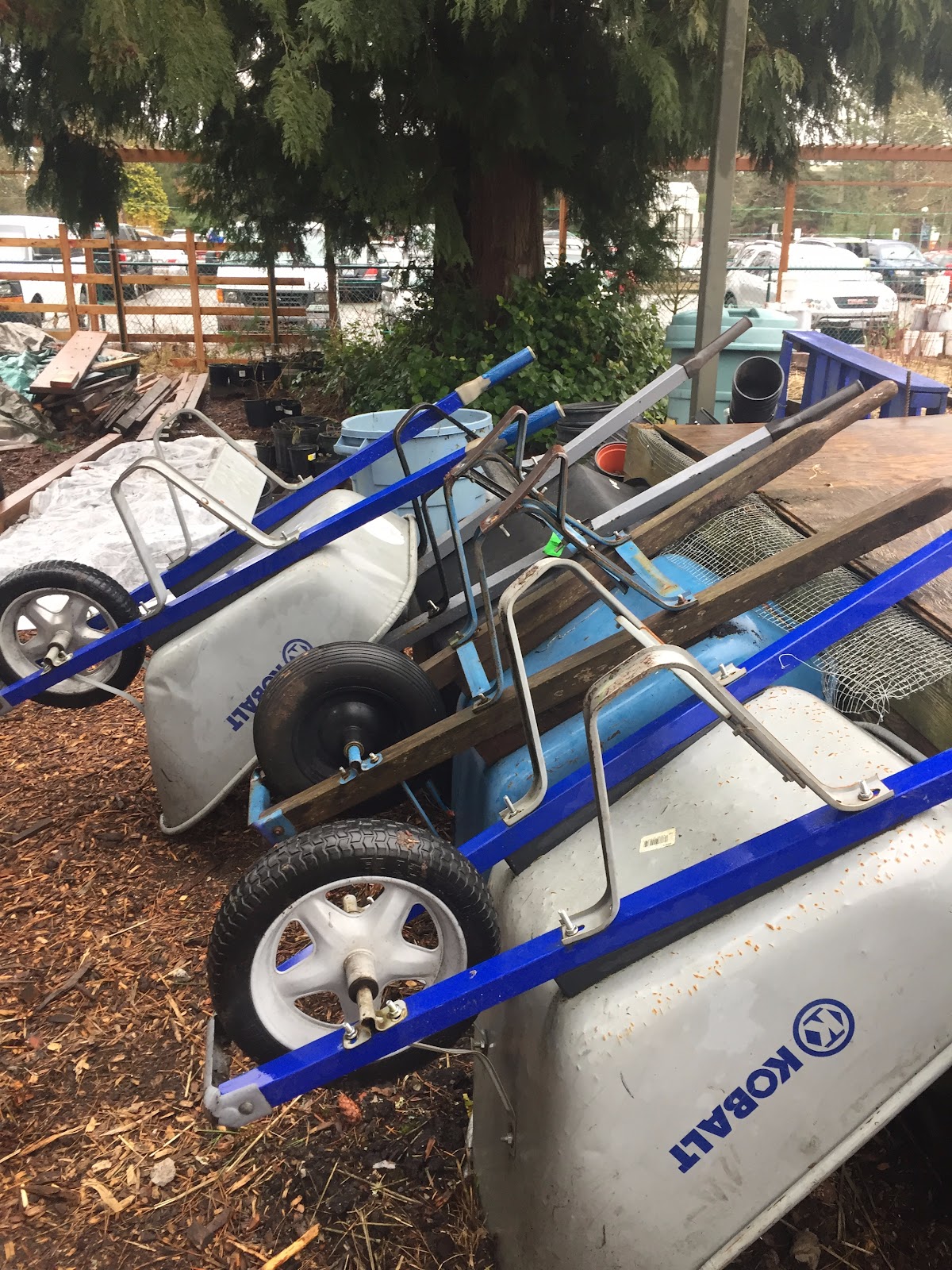
Since I was one of the first participants to get to the courtyard (meeting point) at the start of the event, Zach lead us to the EDCC campus farm to get the wheelbarrow to help in the garbage pick up process.


Our campus farm
Wheelbarrows used to collect trash bags.

My main job was to stay at the station and help Zac scale the initial weight of the garbage bags that were picked up from the main trash bin around campus. We then poured out the contents from the bags into a big plastic mat and started the sorting process.


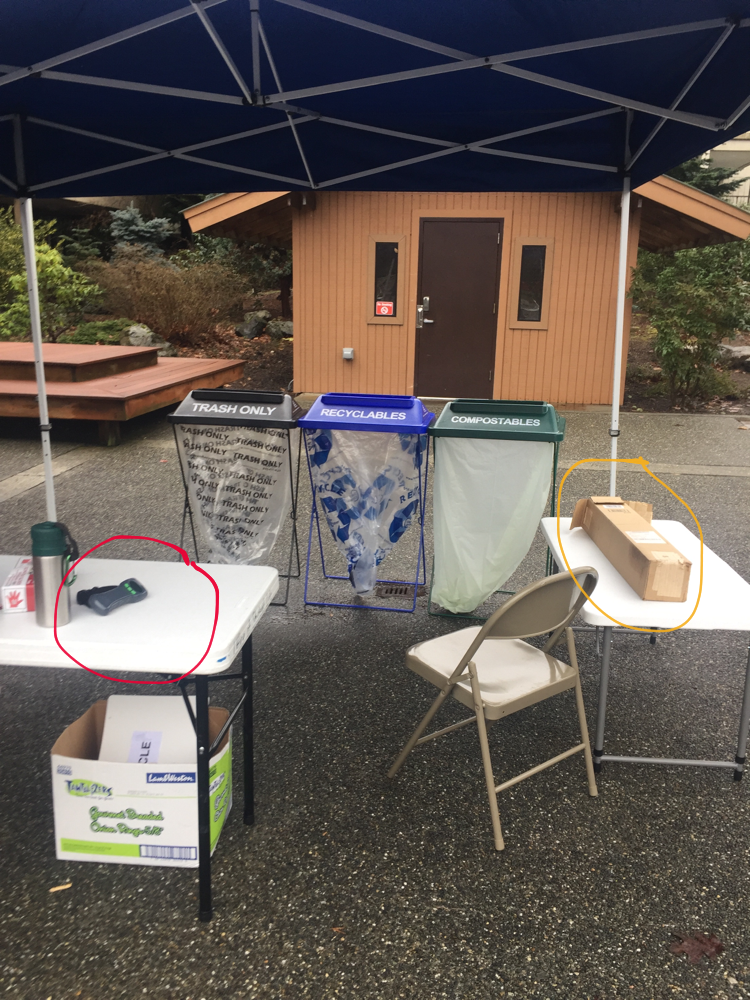
Our trash “playground”
Zac prepared 3 different bags displayed in the picture, labelled: Trash only, recyclables, and compostables. These bags are where we put the correctly sorted out content, with the help of the garbage grabber (circled in yellow). After the sorting was completed, we weighed each of the 3 bags using a hand held digital scale (circled in red) and recorded data.
Summarizing Duties:
Step 1: Weigh the initial mass of each new garbage bags that were brought from
areas around the campus
Step 2: Sort garbage, compost, recycle into the correct bins.
Step 3: Weigh each of the 3 labeled bags after sorting.
Step 4: Repeat step 1 to 3.
I can relate sorting out the trash that was picked up to the idea of building a phylogenetic tree, because we first started by separating the types of waste based on their appearance. We then analyzed the material of the waste to identify whether it’s recyclable or not. Finally, the contents of the bags were placed into its proper bins. This is similar to how we classify organisms by their morphological characteristics and group them based on their similarities. If we considered each category of trash as “phylum” then we can group whatever we find to its respective place based on traits found in each piece of trash, or “taxa”.  The ideas we were taught in Biology can be demonstrated by the activities we perform in our daily life.
Within the 2 hours I was volunteering, I often encountered people incorrectly placing their recyclables or compost into the trash can. Bottles with their liquid still present was a common occurrence. It comes to little surprise that Zach had to sort through all of the trash cans around campus for an entire day. I am concerned about the ecological balance of our campus if these kinds of practices reoccur for a long period of time. Correctly sorting out garbage might not seem as important in our daily routine but it really calls for necessary teamwork in our community. While a group of people work hard to create a better ecological system for everyone, other people seem less mindful of their actions. By working together as a team, even as little as sorting trash correctly, we can improve our ecosystem tremendously.


Questions:
  1. What can be done so that people would dump out liquid from their bottles before they recycle it?
  2. How much funding is needed to increase the ecological balance of EDCC by a noticeable amount?
  3. How much wildlife around EDCC is being harmed by the students disposing habits?
  4. How sustainable would our campus become if every student disposed of just one piece of trash correctly?

Service Learning: Beavers, Woodpeckers, and Tracking in the Big Gulch

                On February 17th 2017, I volunteered at the Wildlife Monitoring in Mukilteo for 3 hours. This can be verified by Grace Coale. She can be contacted at grace.coale@email.edcc.edu.The goals of the event were to learn about the gulch, change the memory on the otter slide and woodpecker cameras, and get an introduction intro tracking using animal paw prints. For the most part, my own duties included trying to identify tracks, paying attention to everything Grace had to teach us, and actively participating in the group activities

After we were dropped of by the van at 92nd Street parks, we walked down a trail to the Big Gulch Trail. 


Off of the trail, we first went to the otter slide cameras. Essential it was a small stream with a camera. Grace, the coordinator, explained how the camera works. However, there was unfortunately a mix-up with logistics, and my coordinator did not have the camera to change the memory in the camera. 


 We got back onto the trial and continued to walk down. We eventually went to the woodpecker tree cameras. Again, we didn't have the key, so we couldn't change the memory. We also looked at a different tree that was marked by another woodpecker species and compared the similarities and differences between the two.


We put coyote attractant, essentially coyote urine, nearby to attract them to the camera.


 We looked at all the fallen trees, and Grace explained how different trees dig into the ground, which affects how likely they are to fall over due to strong winds.


We also looked at the salmon stream. Grace explained how, at first, the city of Mukilteo had made an extremely straight stream without many obstacles. This made the current faster, making it harder for salmon to go upstream to create offspring. As a result, salmon populations rapidly decreased. The city later added obstacles and curvature to the stream to decrease speed, and the salmon population immediately increased the next year.


 We walked back up towards the top of the trail to discuss tracking, using paw prints. First, we learned about dog tracks compared to felines: dogs have claws where as felines retract their claws when walking. Also, we learned to look at not only the tracks, but also the negative space, where there is no indent. Dog tracks usually make an X marking in the negative space. In addition, we learned how size of the animal usually correlates with size of the tracks: coyotes usually have smaller prints than larger dogs. 


Finally, we were able to explore and use this information to find some tracks of our own. Here is a picture of us measuring a track we found using a KTM ruler.


        In this trip, I learned a lot about the interactions between animals and their environment. I also learned about how humans can create huge changes for some animal populations by impacting their environment. For example, I learned how salmon fish populations were negatively affected by man-made fast streams, and I learned how the city of Mukilteo added physical structures to make the stream slower to bring back up salmon populations. I have volunteered in a hospital setting before, however this experience was different because I learned more about helping the community including all different animal populations, not just humans.
        In this quarter, we learned about speciation and how one species can diverge into two species, due to a multitude of reasons. In this project, when I looked at the different woodpecker holes, I clear differences between the two species’ holes: one was much larger, ovular, and father up than the other. This ties into the idea of species, especially behavioral isolation because it is physically evident that they make holes differently

Questions: 
What type of data is obtained from the wildlife cameras and how are they used?
How can tracking techniques, such as the ones we learned be useful in animal biology?
How else have humans impacted other animal populations, such as the salmon population that I mentioned earlier?
How do the types of trees in an ecosystem affect the animal populations present there?


Service learning: Cultural Kitchen cleanup and Repairs by Robert Barker

                I volunteered for three hours in the cultural kitchen. It was a miserable cold, rainy day and I did not get pictures. We learned the background of the cultural kitchen how it was started. A native club on campus wanted a place to cook food related to their culture and a place for telling stories. There are three different ovens. We also learned that Juliene and her dad had just put in a rain gutter. The rain gutter helps filter the rain water so the animals do not have as many pollutants. We also learned that former students had built the benches. After learning a little background, we set off to work.
I had two different jobs throughout the three hours. My main objective was to help pull weeds out from the sand trap. I also helped put rotting wood in the wheelbarrow to put fresh wood down. As I was pulling weeds I uncovered a beetle. All I could tell was that it was a small black oval shaped beetle. This sand trap is used for animals or humans to measure their tracks. The ability for animals to measure their tracks in our cultural kitchen is part of how this project relates to animal biology. Another aspect is that by cleaning the animal’s environment it makes it easier for them to move around.
The goal of this event was to clean and repair the cultural kitchen so that it can be used in future years to the enjoyment that we could. I had helped clean up gold park before so, it was nice to help clean up campus. I had never been to the cultural kitchen and seeing all the science that went into building the stoves and how they work was neat. I love servicing society in any way possible. The contact person to verify my hours is Juliene Wall and she can be reached at julienne.wall@email.edcc.edu.
My four questions that were raised
1)      What is the purpose of measuring your tracks in the sand trap?
2)      Why does campus events not utilize the cultural kitchen more?
3)      What deters more animals from coming into the cultural kitchen?

4)      Why is the sand trap so small? 

Service learning: Restoration at North Acres park.

I went to  Seattle at North acres park ; our goal for the project was to separate invasive plants from native ones, primarily berries. This was necessary because the invasive berries grow out of proportion and occupy the areas that the native ones are meant to grow in. Many of the invasive berries are poisonous when consumed by humans and other Animals. Getting rid of them was a means of saving  us,animals and their habitats.


At the beginning of the project, the organizers described to us the plants to be removed ( invasive) and how they were different from the native ones that we were not suppose to remove because they were pretty similar. We began by removing the invasive berries that were wrapped around the native plants. We were told that if they are allowed to grow all the way to the top of the tree, they pull it down. We then remove the ones on the ground by uprooting the roots. It is important to get the roots to prevent the invasive plants from growing again. 
         The title of the project is "Restoration at North acres Park". It was organised by Earth Corps but our group from edcc was coordinated by Katia (ekaterina.rar@email.edcc.edu). I volunteered for 4 hours. Earth corps works to create healthy environments for nature to thrive. They bring volunteers from schools and individuals to help make their goals a reality. Our project on that day was part of the general goal of a healthy environment for us all. I spent most of the time removing the trailing black berries.
This service learning was very fulfilling for me because not only did we make the park safer for kids that might get one of those poisonous blackberries and eat but we created room for native plants to grow healthy which in turn provides healthy habitat for animals and clean oxygen for us all. All of the above mentioned things could be achieved by just few hours of service learning/ community service; just a few hours to make a massive difference in our communities.
The native and invasive berries must have evolved to have some of them poisonous while others are not, Some native to a place and others invasive. The berries that we call invasive in the pacific North West are native in other places. This made me think these different species might have emerged as a result of allopatric speciation.
Based on my experience I asked the following questions:
1-What if we all take few hours to do something to make a change?
2-How did the invasive plants get here since they are not native?
3-Is there something more I could do to make a difference?
4-If old people work tirelessly to make a difference, why won't the youths do tens times more?
 

Service Learning: Canoe Carving - Francis


Service Learning: Canoe Carving - Francis

I did my service learning project on March 16, 2017. It was a sunny and slightly warm winter day. It was just about the perfect condition for an outdoor activity. I arrived at the Edmonds Community College Cultural Kitchen at 2:45 pm and was going to stay for about an hour but it was not until 5:20 pm that I finally convinced myself to leave. The chilly winds in the evening was also a factor. John Zinser is the one in charge of the Canoe Carving Project at the facility. He carves mostly native American style canoes. He loves to teach student volunteers. His warm and respectful demeanor creates a good atmosphere for learning. We had a good conversation which extended beyond canoes.


Figure 1: A picture of the setting. Canoe lying upside down.


Before we started, John presented me with a safety agreement form which I signed without hesitation. The truth is, carving tools are very sharp and pose many dangers; one needs to be careful when using them. As a beginner, he decided to first show me how to smoothen the rough surfaces. We had to work along the wood grain to avoid damage to the wood. It also made it easy to carve. He did a demonstration with a chisel-looking device called the Slick. During this period, he told me though different types of wood could be used in carving a canoe, what we were working on was cedar. I took over after that and shortly perfected the skill. Cedar was somehow soft and easy to work with. He then showed me how to remove big chunks of wood with another device called Adze. The slightly concave tip of the Adze blade really served its purpose. In a short while, I was on my own and helping build the next canoe.


Figure 2: Picture of me working on the canoe.


Figure 3: A carver using a slick to smoothen a surface. Picture from google.


Figure 4: A carver holding an adze. Picture from google.

One thing that surprised me was when he pulled a spirit level and tried to show me how to balance the sides of the canoe. Who knew carving a canoe required measurements, precision and this amount of detail? I had always thought a canoe needed to be hollow and whatever happened on the outside did not matter much. The carefully measured markings on the base of the canoe reminded me that mathematics and science are important in almost everything we do. By ensuring that the sides are equal, a canoe can balance properly in water.


Figure 5: A spirit level. Picture from google.


Canoes have been around for a long time. Throughout generations, they have been used to move from one place to the other. According to the evolution of locomotion or mobility in animal development, organisms have benefitted by been able to move from one place to the other to find prey or food, to escape predators, to attract mates, to survey their habitat and even to find new breeding places. Canoes have likewise provided humans numerous services. From the ancient days till date, people have used canoes for fishing, hunting, trading, for defense as in wars and to find and colonize new habitats. Crossing waterbodies would be a problem if not for the invention of the canoe and its further evolution.

This service learning project was an adventure and an unforgettable one. Nevertheless, a few questions were raised. Some, John had confident answers but others he was doubtful and even resorted to the many stories that had been told. For instance, he could not specifically tell me the origin of the canoe. However, he adequately answered the questions; why he used the spirit level, the different types of wood used in making a canoe, how he cut the inside of the canoe and why he chose to just be a canoe carver when he could practice other fields of the trade? Though it takes him months to produce a complete canoe, John is devoted to canoe carving and would help anyone learn it. Interested people can reach him at zinsercanoe@gmail.com.