Showing posts with label Lab6-TrilobiteLab-B. Show all posts

Friday, January 27, 2017

Trilobite Estimated Phylogeny Tree -- A Tale of Two Spines (Lab 6)


Trilobite Estimated Phylogeny Tree -- A Tale of Two Spines (Lab 6)
By: Angry Snow People (Ameena Romani, Horea Oprean, Jonathan Hong, Lien Huynh-Phan)


phylogeny tree
Figure 1. An estimated phylogenetic tree showing our interpretation of Trilobite evolution in generations through time.


  1. We chose Pernopsis interstricta as the outgroup because it’s morphology vastly differs from the rest trilobites, with no clear head, tail, or spines.


  1. The basal characteristics are the spine, eyes, and axial rings which were generally present in each generation of Trilobites. The genal spine and tails are the derived traits, appearing first in Ogygopsis klotzi.


  1. The rear spines of species 6 and species 14 are analogous to each other because they both evolved from a most recent common ancestor which did not have spines, and the appearance of a tail spine was lost in the trilobites that evolved from ancestors in between the two spined species.


  1. The appearance of tail spines first appeared in 14 (Dalamites verrucosus), was lost in 7 (Paradoxides gracilis) and reappeared in 6 (Olenelus clarki), although in a different form. The tail spines of D. verrucosus seem to have evolved out of an outcropping on the posterior of the trilobite, separate from the spine of the animal, whereas the spines of the later species such as O. clarki appear directly as extensions of the central column of the back.

5.
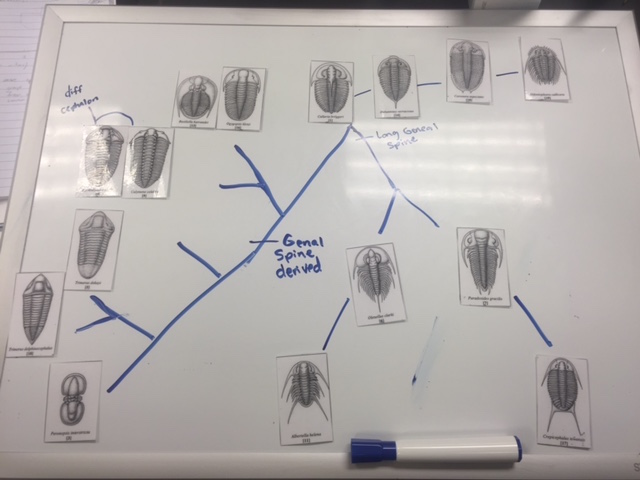

Figure 3. Lily and Heidi’s interpretation of the Trilobite phylogenetic tree throughout generations indicating the evolution.
This group used a different structure of a tree that showed the evolution throughout time. Another distinct feature in their tree is the indication of traits appearing in different generation. However we believe our tree (Figure 1.) is easier to interpret as the structure is easier to follow in a linear manner and is simpler to look at because it is easier to locate certain generations.

Trilobite Tree Lab 6: Phylogenetic Tree for Trilobite

Trilobite Tree Lab 6: Phylogenetic Tree for Trilobite
by Team Fossils Rock
Alondra Sotelo, Jinmei Wang, Radhika Dalal, Sharon Huynh


The purpose of this experiment was to classify 15 trilobites based on their morphologies into a phylogeny. The ensuing phylogeny and analysis follow:


PHYLOGENY:
TRI - Copy.gif
Figure 1. Illustrated above is our Phylogenetic tree of Trilobites made up of 15 morphologically differing trilobites all rooted from a common ancestor.


QUESTIONS:


1. Post a Picture of your tree. On your tree, which species is the outgroup?   Why did you choose this species?  Explain.
In our tree, trilobite three was the outgroup. The initial distinction between our species was the development of an attached or unattached dorsal area. What we mean by this was if the individual extensions from the spine were joined together or were distinct extensions. With regards to this characteristic, when surveying trilobite 3, we saw that its abdomen area was incomparable to that of the rest of the species. In terms of anatomy, the rest of the species that follow in the phylogeny also look remarkably more similar in contrast to trilobite three. This caused us to believe the rest of the species shared a more recent common ancestor than they did with trilobite 3. This is why trilobite 3 was named the outgroup.


2. According to your tree, what is one basal or ancestral characteristic? One derived characteristic?
According to our tree, one basal characteristic is the elongated pleura in trilobite 6, 11, and 19. However, as they evolve, trilobite 19 and 11 developed extremely long genal spines compared to trilobite 6; this makes the long genal spines the derived characteristic.


3. According to your tree, is the rear ‘spine’ of species 6 homologous or analogous (homoplastic) to that of species 14?  Explain.
According to our tree, the rear ‘spine’ of species 6 is analogous to that of species 14 because they evolved from different common ancestors, or convergent evolution. The most recent ancestor of species 6 had long pleura, while the most recent ancestor of species 14 had normal-length pleura.


4. Are there any traits that were lost but then evolved again independently?  ________ If so, what are they and where do they occur?
Yes, one trait that is lost but then evolves again independently is the number of tails on the trilobites. Trilobite 11 and 19 on the phylogeny have developed two tails. On the other hand, trilobite 17, which shares multiple common ancestors with trilobites with a single tail, redevelops this characteristic.


IMG_7201.JPG
Figure 2. The image above is a phylogenetic tree constructed by team “Boys Who Cry” made up of Tommy, Shane, Jonathan and David.


5. Describe one important difference between your tree and a tree estimated by a different lab group.  Upon reflection, which tree seems better?  Why? We compared our phylogeny to Tommy, Shane, Jonathan, and David’s phylogeny. One main difference between our data and this group’s was that it seemed that they picked one characteristic to classify all of their trilobites by (tail shape/amount). On the other hand, our phylogeny used multiple different traits to categorize all of the organisms. The other group’s phylogeny was better because it was more parsimonious. Upon observing their phylogeny, it was evident that all the organisms with similar structures also shared a common ancestor in this tree rather than reappearing in another branch as they did in ours. Both of our phylogenies had an equal number of evolutionary changes, but because their phylogeny was better organized, I would say that their phylogeny was also better.

Thursday, January 26, 2017

Trilobite Tree Lab 6: By The BioBeads (Heidi and Lily)


Systemics Lab

For Lab 5 here is the phylogenic tree of trilobites that Lily and Heidi put together.

 Figure 1. Picture of trilobite tree

1. After reviewing all the species of trilobites we decided that Peronopsis Interstricta was the outgroup for this tree. We came up with this conclusion because this particular organism appeared extremely diverse compared to the other organisms throughout the tree.

2. A basal or ancestral characteristic for all trilobites is that they all have three segments (cephalon, thorax, pygidium) that makes up their physical bodies. A derived characteristic that we noticed was a longer geneal spine later in the tree.

3. When reviewing the rear spine of between species 6 and 14 we concluded from our tree that this trait is analogous. Both of the spines appear different between the two in that the spine of species 6 extends from the axil ring while the spine of species 14 extends from it's plate.

4. In our tree we did have a trait that was lost but then came back again later in evolution. This is seen with the axial ring which first appeared in specie 3, then disappeared in species 18 and 5, then was present again in every specie onwards in the tree.

Figure 2. Other Group's Tree

5. We did observe many differences between our tree and the tree of other lab groups. With our tree we had fewer branches then the tree available in front of the classroom (figure2).   The other tree had many more branches whereas our tree was a bit more linear.  This could be because we only took 4 different traits when building the phylogeny tree.  The 4 traits we looked at were the absent or present of: axial rings, genal spines, longer genal spines, and speckled.  I think ours is easier to look at, while the other group's tree looked more complicated and would need further investigation to pull out the information used to construct it. 


The Discovery of Derived Traits Among Trilobites Representing Evolution

TRILOBITE TREE LAB 6
The Discovery of Derived Traits Among Trilobites Representing Evolution
Team: Chiton Crew
Members: Megan Thees, Jaena Bautista, Nhy Tran, Gretchen Janes


Introduction
In this lab, we constructed the phylogenetic tree of the Trilobites based on different fossils of the organisms. From looking at the generalized Trilobite structure, we can see how derived traits are used to construct a phylogeny tree as understanding Trilobite evolution.

IMG_0842.JPG
Figure 1. A picture of a generalized trilobite, an image we used to distinguish traits of our collection of trilobites


Data Matrix
Organism
Eyes
Pygidium closed
Short Genal Spine
Pygidium short spike (2)
Long Genal Spine
Pygidium Long Spikes (2)
External Spikes (2)
Extended Axis
Cephalon Spikes
Callavia Broggeri (1)
1
0
0
0
1
0
1
1
0
Peronopsis interstricta (3)
0
0
0
0
0
0
0
0
0
Flexicalymene meeki (4)
1
0
0
0
0
0
0
0
0
Trimerus dekayi (5)
1
1
0
0
0
0
0
0
0
Olenellus clarki (6)
1
0
0
0
1
0
1
0
0
Paradoxides gracilis (7)
1
0
0
0
1
0
1
0
0
Calymene celebra (9)
1
0
1
0
0
0
0
0
0
Coronura aspectans (10)
1
0
1
1
0
0
0
0
0
Albertella helena (11)
1
0
0
0
1
1
0
0
0
Basiliella barrandei (13)
1
0
0
0
1
0
0
0
0
Dalamnites verrucosus (14)
1
0
1
0
0
0
0
0
0
Ogygopsis klotzi (16)
1
0
0
0
1
0
0
0
0
Crepicephalus towensis (17)
1
0
0
0
1
1
0
0
0
Trimerus delphinocephalus (18)
1
0
0
0
0
0
0
0
0
Odontopleura
callicera (19)      
1
0
0
0
1
0
1
0
1
Table 1 is a data matrix of traits we found compared across different fossils of Trilobites. The 1 represents the appearance of this trait and the 0 represents the absence of this trait


Trilobite Phylogeny Tree


16145835_1389223641096442_1729097210_o.jpg

Figure 1. Is a picture of the phylogeny tree we created based on traits that we believed were derived over time. Some of the traits we observed were the presence of eye, closed pygidium, short and long genal spines, short and long pygidium spikes, external and internal axis and cephalon spikes. The genus and species of the trilobites and their respective numbers are: Callavia Broggeri (1) Peronopsis interstricta (3) Flexicalymene meeki (4) Trimerus dekayi (5) Olenellus clarki (6) Paradoxides gracilis (7) Calymene celebra (9) Coronura aspectans (10) Albertella helena (11) Basiliella barrandei (13) Dalamnites verrucosus (14) Ogygopsis klotzi (16) Crepicephalus towensis (17) Trimerus delphinocephalus (18) Odontopleura callicera (19).  

Questions:
  1. Which is the outgroup? Why?
We decided that Personopsis interstricta (3) would be the outgroup on our phylogeny tree because it looked the most different from all the other species and also the least complex so we believe that it was the closest to the common ancestor.

  1. What is one ancestral characteristic? What is one derived characteristic?
Ancestral characteristic: Internal axis
Derived characteristic: Eyes

  1. According to your tree, is the rear ‘spine’ of species 6 homologous or analogous to that of species 14? Explain
Homologous means having similarities in traits due to common ancestry whereas, analogous is having similarities in traits that are not due to common ancestry. According to our tree, the rear ‘spine’ of species 6 and 14 evolved in different periods independently (it may be due to their way of living and to survive in their current environment). Therefore, it is not due to common ancestry which means they are analogous.

  1. Are there any traits that were lost but then evolved again independently? If so what are they and where do they occur?
Internal axis in Paradoxides gracilis (7) was lost but evolved again independently.

  1. Describe one important difference between your tree and a tree estimated by a different lab group. Upon reflection, which tree seems better? Why?
IMG_7201.JPG16145835_1389223641096442_1729097210_o.jpg

Figure 2. A side by side comparison of Tommy, Shane, Jonathan and David’s tree (left) and ours (right).

Their tree is a cladogram where ours is a phylogeny tree, where both show the relationship between the Trilobites,  our phylogenetic tree has branches that represent evolutionary time and amount of change (hypothetical of course) and an undistinguished head or tail. Both of our trees show the outgroup being Peronopsis interstricta (3), we both agree that this is the outgroup because it seems to be the most basic Trilobite, lacking spinal rings unlike every other trilobite in this collection. Their cladogram seems to have more branches than our phylogeny tree making it more complex and more challenging to see the relationship between trilobites.  Both trees are well done, but we think that ours is easier to understand but maybe that is just because we created it!